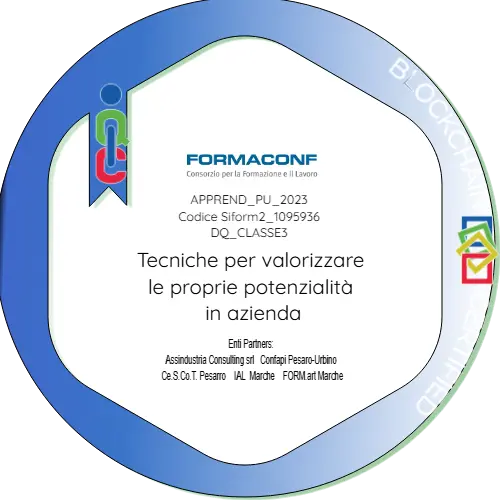
SEZ2_5.8_Tecniche per valorizzare le proprie potenzialità in azienda_DQ3
FORMACONF – CONSORZIO PER LA FORMAZIONE E IL LAVORO
Giovanni Debellis
08/08/2024
08/08/2026
Assertion
ΣΥΜΒΟΛΑΙΟΓΡΑΦΙΚΉ ΕΠΙΚΎΡΩΣΗ ΣΤΟ BLOCKCHAIN
Polygon (0x89)
0x086757953eba853ec1d0547249ab804448b941a9
545073
15e78008e06a54bb1596adf67aa747c25505e7a802bd7c8650e245cb4391cbc6
15e78008e06a54bb1596adf67aa747c25505e7a802bd7c8650e245cb4391cbc6
Vedi sul block Explorer
Cos'è
Notarizzazione
Η συμβολαιογραφική πράξη blockchain είναι μια διαδικασία που σας επιτρέπει να εγγυηθείτε την αυθεντικότητα και την ακεραιότητα ενός τμήματος δεδομένων μέσω αμετάβλητης εγγραφής σε ένα αποκεντρωμένο δίκτυο, διασφαλίζοντας την ιχνηλασιμότητά του και καθιστώντας το απαραβίαστο.
Η συμβολαιογραφική επικύρωση ενός κατακερματισμού επιτρέπει τη διατήρηση της εμπιστευτικότητας των μη κρυπτογραφημένων δεδομένων, καθώς ο κατακερματισμός είναι μια μονόδρομη κρυπτογραφική αναπαράσταση που δεν μπορεί να μετατραπεί ξανά στα αρχικά δεδομένα, προστατεύοντας έτσι την εμπιστευτικότητά του κατά τη διαδικασία εγγραφής και επικύρωσης στο blockchain.
Json e Hash
Json
Το JSON είναι μια ελαφριά μορφή δεδομένων που χρησιμοποιείται για την αναπαράσταση δομημένων πληροφοριών, όπως αντικείμενα και πίνακες. Είναι εύκολα αναγνώσιμο από μηχανές και χρησιμοποιείται ευρέως για ανταλλαγή δεδομένων μεταξύ εφαρμογών.
Το JSON ενός ισχυρισμού C-BOX μπορεί να ανακτηθεί στην ακόλουθη διεύθυνση. Αυτή η διεύθυνση URL αποθηκεύεται στο blockchain στη διεύθυνση Αυτή η διεύθυνση.
https://api.cboxiqc.com/api/v1.0/Blockchain/NotarizedAssertion/545073
Hash
Ο κατακερματισμός SHA-256 (Secure Hash Algorithm 256-bit) είναι ένας κρυπτογραφικός αλγόριθμος που μετατρέπει μια είσοδο δεδομένων οποιουδήποτε μεγέθους σε κατακερματισμό σταθερού μήκους 256 bit. Ο κατακερματισμός που δημιουργείται από το SHA-256 είναι μοναδικός για κάθε συγκεκριμένη είσοδο και προσφέρει υψηλή ασφάλεια, καθώς ακόμη και η παραμικρή αλλαγή στα δεδομένα εισόδου οδηγεί σε εντελώς διαφορετικό κατακερματισμό.
Για το λόγο αυτό, μπορεί να θεωρηθεί δακτυλικό αποτύπωμα των μη κρυπτογραφημένων δεδομένων.
Αυτός ο αλγόριθμος χρησιμοποιείται ευρέως για την προστασία της ακεραιότητας των δεδομένων και τη διασφάλιση της εμπιστευτικότητας, λόγω της αντοχής του στην αναστρεψιμότητα και της ικανότητάς του να αντέχει σε επιθέσεις ωμής βίας.
Assertion
Json του ισχυρισμού

Evaluating hash

Comparison
Blockchain comparison